Leaving school at 14 after being evacuated three times, I lasted out nearly a week in a Wanstead garage the shortness being
due to crossing the thread while changing a spark plug on the guvnor's Jaguar SS. Dad got me a job at Dunne &
Co (if you want to get ahead, get a hat) in Leytonstone tone High Road. A week later I was disposed of having
failed the dress code after a visit from the area manager.
An office job (post boy) in the shipping world of Leadenhall Street followed.
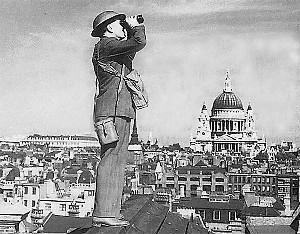
When an air raid sounded, I often did fire watch duty on the roof. If a plane was spotted approaching, an alarm bell was rang
and the staff (and bell ringer) would scurry down to the basement. The Managing Director was Clinton Hiram Kemp; I could forge
his signature to this day. He mysteriously came and went with a brief case chained to his wrist. Was he CIA? Did the CIA exist
then? US Lines telephone number was Royal 6677. Funny, I remember that to this day while not sure of my own mobile number.
When my dad was invalided out
of the army in 1943, I reluctantly left the shipping industry to help dad who had found an empty shop adjoining the Rex cinema
in Leytonstone High Road. Here, Scott's Buffet was born. Dad and I worked all night for (what seemed like) weeks decorating,
making and fitting counters and generally getting ready for the launch. When air raids subsided a huge new window was installed
without shatter glass strips. One morning, after cleaning this beautiful window a V2 rocket fell nine hundred yards away and
blew the entire window outwards - my charmed life had begun. (See War. What is it Good For?).
The buffet was a great success and became a haven of rest for American Air Force personnel, thanks largely to mum's
superb coffee and cuisine, which she insisted had to be of a standard as if feeding her family.
Being close to the Burghley Hall, a popular dance
hall hot spot of the time, the alternating bands would spend their break times in Scott's Buffet and in one of these breaks
I fortuitously met boy wonder drummer Kenny Clare. Previously I did two paper rounds and a milk round on Saturdays which
now enabled me to purchase a second hand John Grey drum kit. Dad thought I was demented. I did gigs in a quartet most
weekends, often carrying my kit home from the bus station as anti-aircraft guns on the Wanstead Flats hammered at unseen German airplanes overhead.
Later, I further experimented with the clarinet
and trombone. - both doomed. Dad would shake his head in disgust, You should have learnt a trade boy. Mum and dad
always called me boy. I detested my given name Walter, choosing a middle name Charles (Charlie? no thanks!) or Edward,
shortened sometimes to Eddie, or Ted. No wonder they got confused and kept to boy.
During National Service, I played in bigger dance bands, where my drumming
expertise was seriously exposed. (see This Is The Army Mr. Ted). Much later I bought a Conn alto saxophone and was tutored by Cecil Pressling
the lead alto in the Oscar Rabin Band. Being an avid modern jazz fan, I tended to run long before I could walk
and the saxophone went the way of the previous instrumental aspirations. Having moved from café to café several
times, mum and dad found the work arduous and tiring. Sixteen hour days were not uncommon and it was no life for me or my
sisters. Dad seeked pastures new!
Kenny Clare had served his National Service in the RAF and we had always kept in touch. One weekend I stayed with
Kenny and told him the future, for me, looked bleak. I told him I might have to actually find a job. After much speculation
he suggested I go into the disc-cutting business. He recounted the success of someone he had met in the States. Kenny by this
time was drumming aboard the QE1 the New York/Southampton 'ferry' bringing back priceless jazz albums unavailable
in the UK. Why didn't I get a recording outfit and bootleg these albums for hungry modern jazz addicts? Make a disc?
What on earth doe that entail? On the other hand, it sounded like a lifeline to me and exciting to boot.
My father was down to his last
few hundred pounds and after scouring the phone books we went to the MSS Recording Company in Colnbrook, near Heathrow and spent nearly £600 on equipment that,
despite a lengthy demonstration by a charming Mr. Pemberton, I retained only the haziest idea of the four hours tuition. £600
in 1951 was a lot of dosh, had I wasted dad's money. In retrospect, considering his total inability to comprehend the
mysterious equipment he had paid for, his faith in me was astounding probably tinged with desperation! After much experimentation,
I discovered I had knack for the art of acetate disc cutting and even more so an ear for sound mixing.